Winter Sale - Limited Time 65% Discount Offer - Ends in 0d 00h 00m 00s - Coupon code: top65certs

GMAT Exam Dumps : Graduate Management Admission Test (2022)

PDF
GMAT pdf
 Real Exam Questions and Answer
 Last Update: Dec 11, 2025
 Question and Answers: 465
 Compatible with all Devices
 Printable Format
 100% Pass Guaranteed
$29.75  $84.99
GMAT exam
PDF + Testing Engine
GMAT PDF + engine
 Both PDF & Practice Software
 Last Update: Dec 11, 2025
 Question and Answers: 465
 Discount Offer
 Download Free Demo
 24/7 Customer Support
$47.25  $134.99
Testing Engine
GMAT Engine
 Desktop Based Application
 Last Update: Dec 11, 2025
 Question and Answers: 465
 Create Multiple Test Sets
 Questions Regularly Updated
  90 Days Free Updates
  Windows and Mac Compatible
$35  $99.99
Last Week Results
32 Customers Passed Admission Tests
GMAT Exam
Average Score In Real Exam
86.7%
Questions came word for word from this dump
88.6%
Admission Tests Bundle Exams
 Duration: 3 to 12 Months
 2 Certifications
  2 Exams
 Admission Tests Updated Exams
 Most authenticate information
 Prepare within Days
 Time-Saving Study Content
 90 to 365 days Free Update
$291.2*
Free GMAT Exam Dumps

Verified By IT Certified Experts

CertsTopics.com Certified Safe Files

Up-To-Date Exam Study Material

99.5% High Success Pass Rate

100% Accurate Answers

Instant Downloads

Exam Questions And Answers PDF

Try Demo Before You Buy

Certification Exams with Helpful Questions And Answers

Graduate Management Admission Test (2022) Questions and Answers

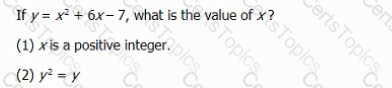
Question 1

Options:

A.

Statement (1) ALONE is sufficient, but statement (2) alone is not sufficient.

B.

Statement (2) ALONE is sufficient, but statement (1) alone is not sufficient.

C.

BOTH statements TOGETHER are sufficient, but NEITHER statement ALONE is sufficient.

D.

EACH statement ALONE is sufficient.

E.

Statements (1) and (2) TOGETHER are NOT sufficient.

Buy Now
Question 2

Sales promotions can involve selling a product at a relatively low price or selling the product with a free (or seemingly free) unit of the product, as in "buy one, get one free" campaigns. Research shows that immediately following month-long sales promotions, a postpromotion dip may occur, i.e., sales for the following calendar month may be less than sales for the calendar month preceding the sales promotion.

To increase sales, Storex, a department store, held month-long sales campaigns to promote four of its products. A sales promotion was considered successful if unit sales of the product were at least 10% higher in each of the 2 calendar months immediately following the promotion than In the month preceding it.

Experts have offered explanations for postpromotion dip:

• Explanation I: Many consumers stockpile the product at relatively low cost during the sales promotion.

• Explanation II: "Buy one, get one free" promotions cause some consumers to undervalue the product, making them less likely to buy it following the sales promotion.

• Explanation HI: Many consumers who missed a "buy one, get one free" opportunity may, as a result, develop so-called inaction inertia, i.e., become less likely to buy the product at either the regular or even at a discount price than if the sales promotion had not occurred.

Which one of the following is most strongly supported by the sales data, given the other Information provided?

Options:

A.

The April sales promotion for Product B was ineffective, unnecessary, or both.

B.

Consumers sought to stockpile Product B immediately following the April sales promotion.

C.

No postpromotion dip in Product B sales resulted from a sales promotion held in the six-month period.

D.

Sales of Product B would have increased in May and June even if there had been no sales promotion.

E.

There had been a largely ineffective sales promotion of Product B in the preceding December.

Question 3

At a carnival game, a winning player spins a wheel that always lands on either Prize 1 or Prize 2 to determine which of the two prizes he or she wins. The probability that the prize wheel indicates Prize 2 Is double the probability that It indicates Prize 1. If a player does not want the prize that the prize wheel first indicates, then he or she may spin the wheel again. In such cases, the player must accept whichever prize the prize wheel indicates on the second spin.

Select for Prize I the number nearest to the probability that a winning player who wants Prize 1 will receive Prize 1 after one or two spins of the prize wheel, and select for Prize ^the number nearest to the probability that a winning player who wants Prize 2 will receive Prize 2 after one or two spins of the prize wheel. Make only two selections, one in each column.

Options: