
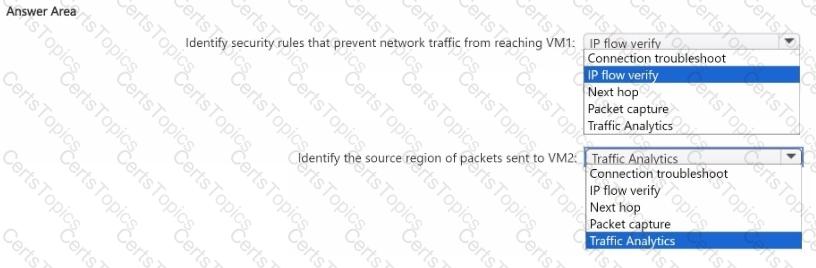
You have an Azure subscription. The subscription contains two virtual machines named VM1 and VM2 that run Windows Server. You need to use Azure Network Watcher to meet the following requirements;
• Identify security rules that prevent network traffic from reaching VM1.
• Identify the source region of packets sent to VM2.
What should you use for each requirement? To answer, select the appropriate options in the answer area.
NOTE: Each correct selection is worth one point.
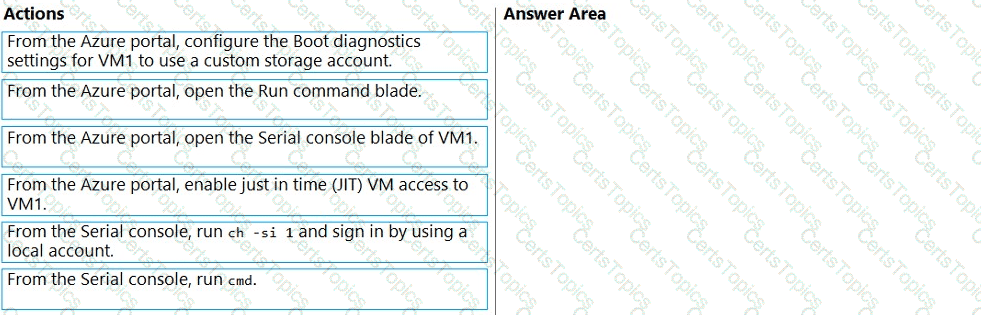
You have an Azure virtual machine named VM1 that runs Windows Server. VM1 has boot diagnostics configured to use a managed storage account.
You are troubleshooting connectivity issue on VM1.
You need to run a PowerShell cmdlet on VM1 by using the Azure Serial Console.
Which four actions should you perform in sequence? To answer, move the appropriate actions from the list of actions to the answer area and arrange them in the correct order.
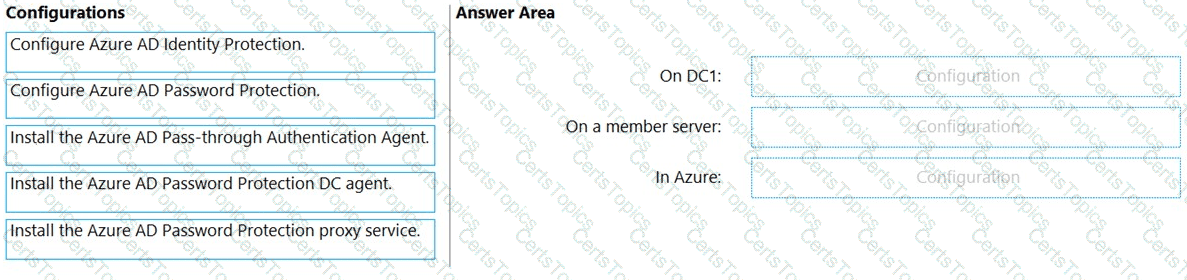
You have an on-premises Active Directory Domain Services (AD DS) domain that syncs with an Azure Active Directory (Azure AD) tenant.
The AD DS domain contains a domain controller n amed DC1. DC1 does NOT have internet access.
You need to configure password security for on-premises users. The solution must meet the following requirements:
Prevent the users from using known weak passwords.
Prevent the users from using the company name in passwords.
What should you do? To answer, drag the appropriate configurations to the correct targets. Each configuration may be used once, more than once, or not at all. You may need to drag the split bar between panes or scroll to view content.
NOTE: Each correct selection is worth one point.
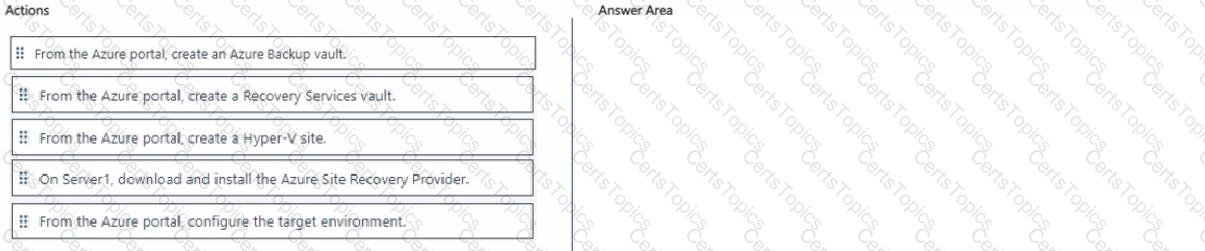
You have an on-premises server named Server1 that runs Windows Server and has the Hyper-V server role installed. Server1 hosts a virtual machine named VM1 that runs Windows Server.
You need to protect VM1 by using Azure Site Recovery. The solution must use Azure as the disaster recovery site.
Which four actions should you perform in sequence? To answer, move the appropriate actions from the list of actions to the answer area and arrange them in the correct order.
You have the on-premises servers shown in the following table.

You have an Azure subscription.
You plan to migrate the servers to Azure generation 2 virtual machines. Which servers can be migrated to Azure by using Azure Migrate?
You have two physical servers named AppSrv1 and AppSrv2 and an unconfigured server named Server1. All the servers run Windows Server. Only Server1 can access the internet.
You plan to use Azure Site Recovery to replicate AppSrv1 and AppSrv2 to Azure.
You need to deploy the required components to AppSrv1, AppSrv2, and Server1.
Which components should you deploy? To answer, drag the appropriate components to the correct servers. Each component may be used once, more than once, or not at all. You may need to drag the split bar between panes or scroll to view content.
NOTE: Each correct selection is worth one point.

You have an Azure virtual machine named VM1 that runs Windows Server.
The operating system on VM1 fails to fully initialize its network stack, and you cannot establish a network connection.
You need to establish an interactive shell session.
What should you use?
You need to use a comma-separated value (CSV) file to import server inventory to Azure Migrate. Which fields are mandatory for each entry in the CSV file?
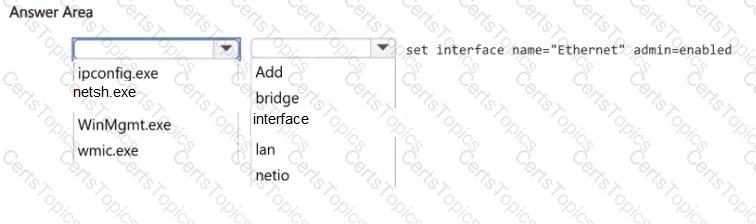
You have an Azure subscription. The subscription contains a virtual machine named VM1 that runs Windows Server.
The network interface for VM1 is disabled in the operating system.
You need to enable the network interface by using the Azure Serial Console.
How should you complete the command? To answer, select the appropriate options in the answer area.
NOTE: Each correct selection is worth one point.
You deploy Azure Migrate to an on-premises network.
You have an on-premises physical server named Server1 that runs Windows Server and has the following configuration.
* Operating system disk 600 GB
* Data disic 3 TB
* NIC Teaming: Enabled
* Mobility service: installed
* Windows Firewall: Enabled
* Microsoft Defender Antivirus: Enabled
You need to ensure that you can use Azure Migrate to migrate Server1.
Solution: You disable NIC Teaming on Server1.
Does this meet the goal?
You have three servers named Server1. Server1 and Server3 that run Windows Server and have the hyper V server rote installed. Server 1 hosts an Azure Migrate appliance named Migrate1.
You plan to migrate virtual machines to Azure.
You need to ensure that any new virtual machines created on Server 1. Server2 and Server3 are available in Azure Migrate
What should you do?
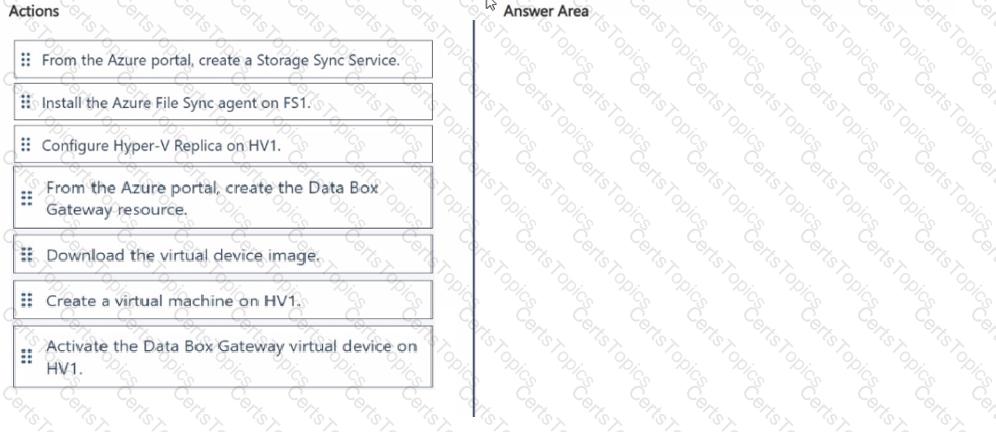
Your on-premises network contains an Active Directory Domain Services (AD DS) domain. The domain contains the servers shown in the following table.

You have an Azure subscription.
You plan to migrate the data on FS1 to Azure by using Azure Data Box Gateway.
You need to configure a Data Box Gateway virtual device.
Which four actions should you perform in sequence? To answer, move the appropriate actions from the list of actions to the answer area and arrange them in the correct order.
You have two servers that have the Web Server (IIS) s erver role installed. The servers are configured as shown in the following table.

Both servers are configured to enable website deployment by using the Web Deployment Tool. Server1 hosts a website named Site1 that has Web Deploy Publishing configured.
You plan to migrate Site1 to Server2.
You need to perform a pull synchronization of Site1 by using the Web Deployment Agent Service.
How should you complete the command? To answer, select the appropriate options in the answer area.
NOTE: Each correct selection is worth one point.

You have a failover cluster named Cluster1 that has the following configurations:
Number of nodes: 6
Quorum: Dynamic quorum
Witness: File share, Dynamic witness
What is the maximum number of nodes that can fail simultaneously while maintaining quorum?
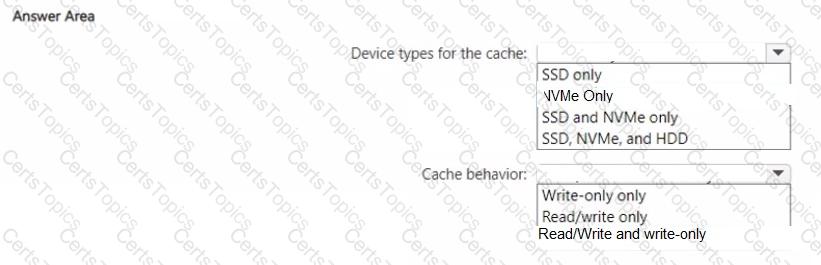
You have four servers that run Windows Server. Each server has the direct-attached storage (DAS) devices shown in the following table.
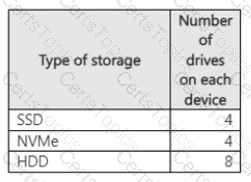
You need to deploy Storage Spaces Direct.
Which types of devices will be used for the cache, and what will be the default cache behavior? To answer, select the appropriate options in the answer area.
NOTE: Each correct selection is worth one point.
Your network contains an Active Directory Domain Services (AD DS) domain that contains the servers shown in the following table.

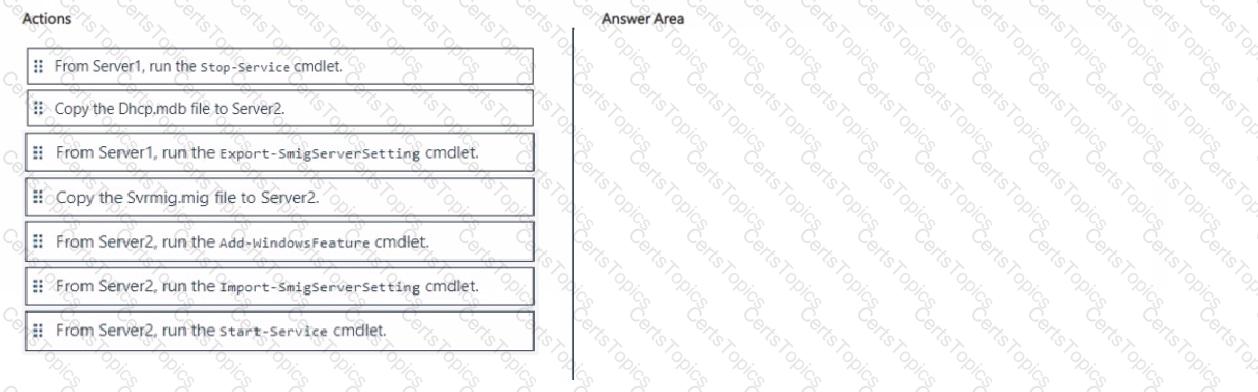
Server1 and Server2 are authorized as DHCP servers in the domain. You need to migrate the DHCP Server role from Server1 to Server2. Which five actions should you perform in sequence? To answer, move the appropriate actions from the list of actions to the answer area and arrange them in the correct order.
You have an Azure virtual machine named VM1 that runs Windows Server.
The operating system on VM1 fails to start due to a disk error.
You need to resolve the error.
Which four commands should you run in sequence in Azure Cloud Shell? To answer, move the appropriate commands from the list of commands to the answer area and arrange them in the correct order.

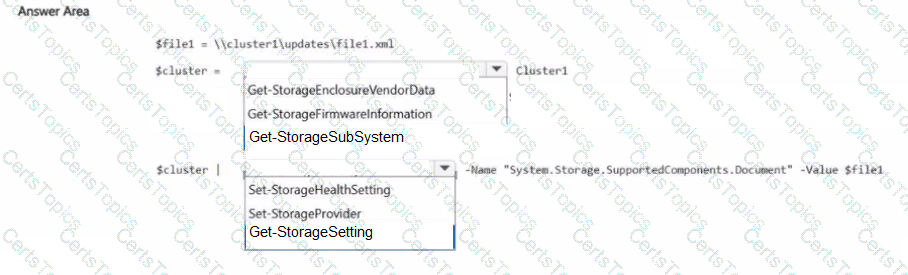
You have a Storage Spaces Direct cluster named Cluster1 that contains multiple nodes.
You have a firmware update for the hard disks attached to each node.
You create a configuration file named FileLxm1 for the update.
You need to automate the rollout of the firmware update to the nodes of Cluster1. The solution must minimize downtime of the workloads hosted in Cluster1.
How should you complete the PowerShell commands? To answer, select the appropriate options in the answer area.
NOTE: Each correct selection is worth one point.
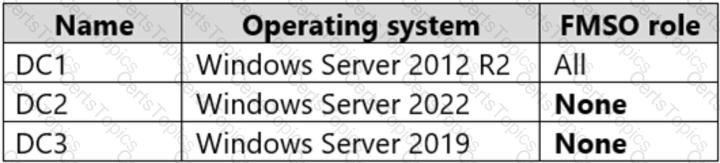
Your network contains an Active Directory Domain Services (AD DS) domain named contoso.com. T he functional level of the forest and the domain is Windows Server 2012 R2. The domain contains the domain controllers shown in the following table.
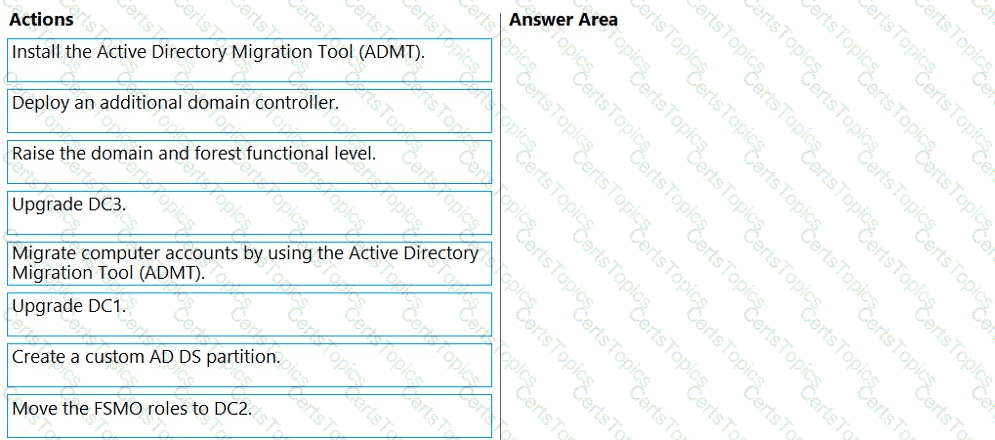
You need to raise the forest functional level to Windows Server 2016. The solution must meet the follow ing requirements:
Ensure that there are three domain controllers after you raises the level.
Minimize how long the FSMO roles are unavailable.
Which three actions should you perform in sequence? To answer, move the appropriate actions from the list of ac tions to the answer area and arrange them in the correct order.
You have a Microsoft Sentinel deployment and 100 Azure Arc-enabled on-premises servers. All the Azure Arc-enabled resources are in the same resource group.
You need to onboard the servers to Microsoft Sentinel. The solution must minimize administrative effort.
What should you use to onboard the servers to Microsoft Sentinel?
You have a server named Server1 that runs Windows Server.
You need to ensure that only specific applications can modify the data in protected folders on Server1.
Solution: From App & browser control, you configure the Reputation-based protection.
Does this meet the goal?
Note: This question is part of a series of questions that present the same scenario. Each question in the series contains a unique solution that might meet the stated goals. Some question sets might have more than one correct solution, while others might not have a correct solution.
After you answer a question in this section, you will NOT be able to return to it. As a result, these questions will not appear in the review screen.
You have a failover cluster named Cluster1 that hosts an application named App1.
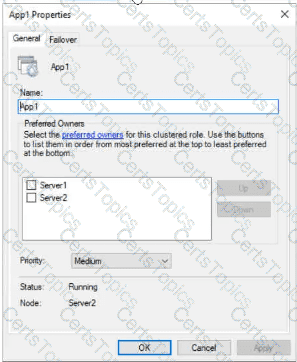
The General tab in App1 Properties is shown in the General exhibit. (Click the General tab.)
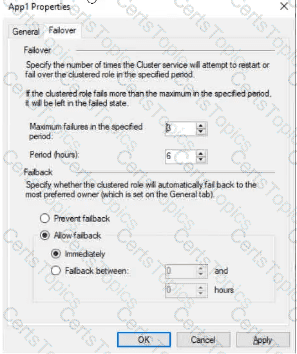
The Failover tab in App1 Properties is shown in the Failover exhibit. (Click the Failover tab.)
Server1 shuts down unexpectedly.
You need to ensure that when you start Server1, App1 continues to run on Server2.
Solution: From the General settings, you move Server2 up.
Does this meet the goal?
Your network contains an Active Directory Domain Services (AD DS) domain. The domain contains two servers named Server1 and S erver2 that run Windows Server.
You need to ensure that you can use the Computer Management console to manage Server2. The solution must use the principle of least privilege.
Which two Windows Defender Firewall with Advanced Security rules should you ena ble on Server2? Each correct answer presents part of the solution.
NOTE: Each correct selection is worth one point.
You have a server named Server1 t hat runs Windows Server.
On Server1, you create a Data Collector Set named CollectorSet1 based on the Basic template.
You need to configure CollectorSet1 to meet the following requirements:
Older performance counter logs must be overwritten by new ones.
Performance counter logging must stop if there is less than 500 MB of free disk space.
What should you configure for each requirement? To answer, select the appropriate options in the answer area.
NOTE: Each correct selection is worth one point.

Your on-premises network has a 200-Mbps connection to Azure and contains a server named Server1 that stores 70 TB of data files.
You have an Azure Storage account named storage 1.
You plan to migrate the data files from Server1 to a blob storage container in storage!. Testing shows that copying the data files by using azcopy will take approximately 35 days.
You need to minimize how long it will take to migrate the data to Azure.
What should you use?
You have an Active Directory Domain Services (AD DS) forest that has the Active Directory Recycle Bin enabled. The forest contains a user named User1.
User1 is accidentally deleted.
You need to restore User1 from the Active Directory Recycle Bin.
What should you use?
You have an Active Directory Domain Services (AD DS) domain. The domain contains a server named Server1 that runs Windows Server.
You need to prevent the registration of specific COM objects on Server1.
What should you use?
You have an on-premises server named Server1 that runs Windows Server.
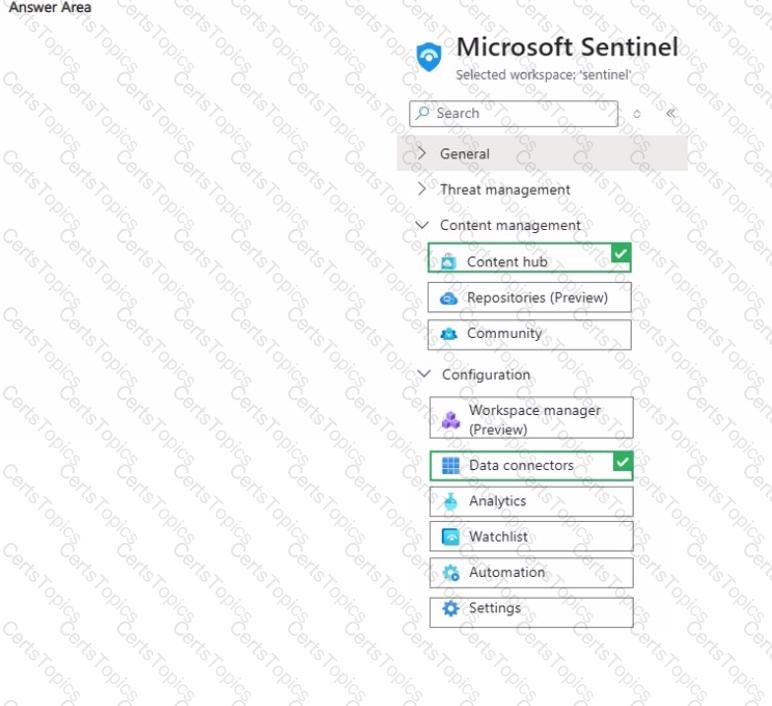
You have a Microsoft Sentinel workspace named sentinel.
You need to collect Windows Defender Firewall events from Server1 to sentinel.
Which two pages should you use in the Azure portal? To answer, select the appropriate pages in the answer area.
NOTE: Each correct selection is worth one point.
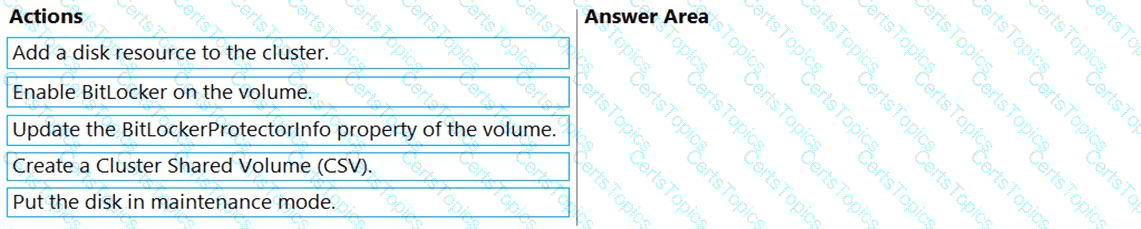
You are planning the implementation of Cluster2 to support the on-premises migration plan.
You need to ensure that the disks on Cluster2 meet the security requirements.
In which order should you perform the actions? To answer, move all actions from the list of actions to the answer area and arrange them in the correct order.
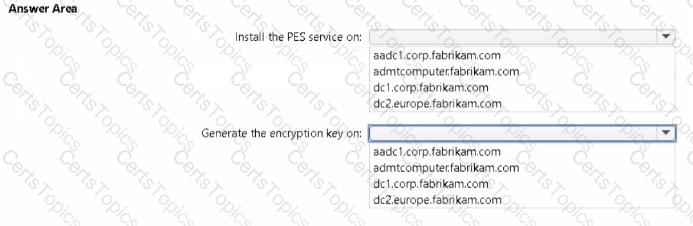
You are planning the europe.fabrikam.com migration to support the on-premises migration plan-Where should you install the Password Export Server (PES) service, where should you generate the encryption key? To answer, select the appropriate options in the answer area.
NOTE: Each correct selection is worth one point.
You are planning the data share migration to support the on-premises migration plan.
What should you use to perform the migration?
You are planning the migration of Archive1 to support the on-premises migration plan.
What is the minimum number of IP addresses required for the node and cluster roles on Cluster3?
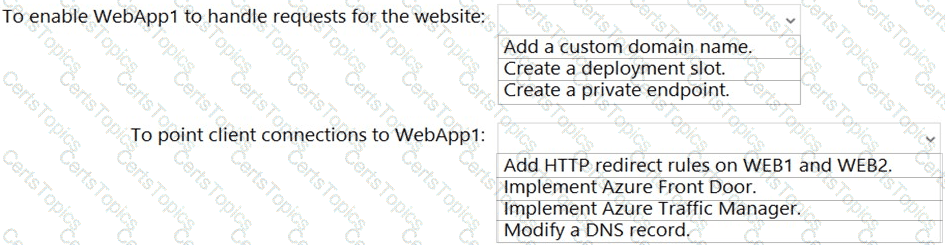
You are planning the website migration to support the Azure migration plan.
How should you configure WebApp1? To answer, select the appropriate opti ons in the answer area.
NOTE: Each correct selection is worth one point.
You are remediating the firewall security risks to meet the security requirements.
What should you configure to reduce the risks?
You are planning the deployment of Microsoft Sentinel.
Which type of Microsoft Sentinel data connector should you use to meet the security requirements?
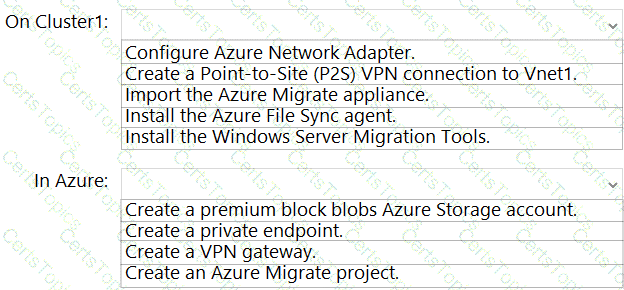
You are planning the migration of APP3 and APP4 to support the Azure migration plan.
What should you do on Cluster1 and in Azure before you perform the migration? To answer, select the appropriate options in the answer area.
NOTE: Each correct selection is worth one point.
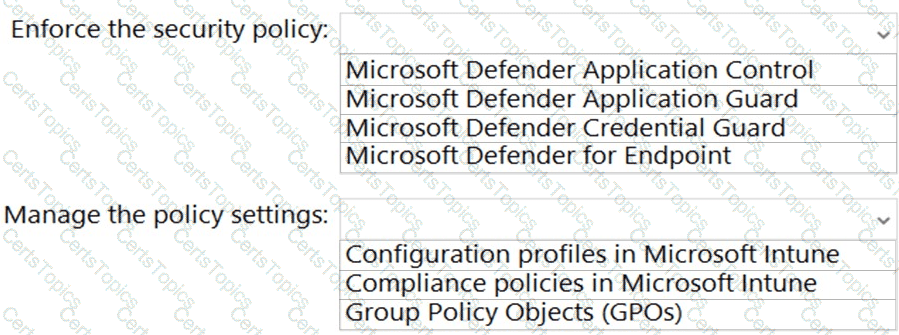
You need to implement a security policy solution to authorize the applications. The solution must meet the security requirements.
Which service should you use to enforce the security policy, and what should you use to manage the policy settings? To answer, select the appropriate options in the answer area.
NOTE: Each correct selection is worth one point.
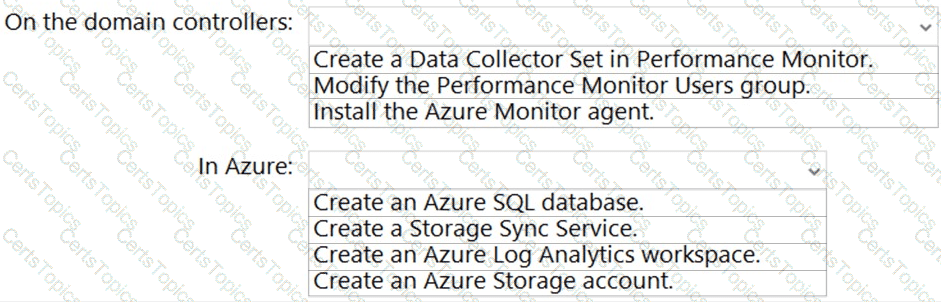
You need to implement alerts for the domain controllers. The solution must meet the technical requirements.
What should you do on the domain controllers, and what should you create on Azure? To answer, select the appropriate options in the answer area.
NOTE: Each correct selection is worth one point.
You need to meet the technical requirements for User1.
To which group in contoso.com should you add User1?
Which domain controller should be online to meet the technical requirements for DC4?
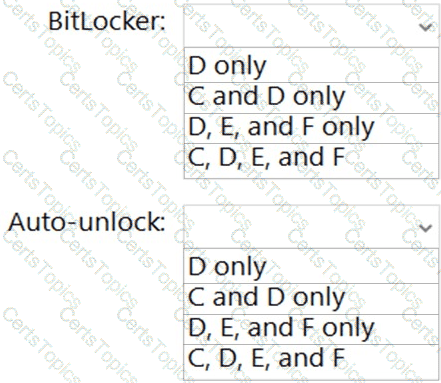
You need to configure BitLocker on Server4.
On which volumes can you tu rn on BitLocker, and on which volumes can you turn on auto-unlock? To answer, select the appropriate options in the answer area.
NOTE: Each correct selection is worth one point.
You need to back up Server 4 to meet the technical requirements.
What should you do first?
You are evaluating the technical requirements tor Cluster2.
What is the minimum number of Azure Site Recovery Providers that you should install?
You need to meet technical requirements for Share1.
What should you use?
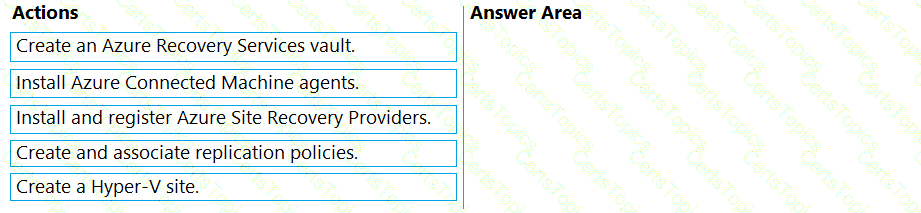
You need to meet the technical requirements f or Cluster2.
Which four actions should you perform in sequence before you can enable replication? To answer, move the appropriate actions from the list of actions to the answer area and arrange them in the correct order.
You need to meet the technical requirements for Cluster3.
What should you include in the so lution?
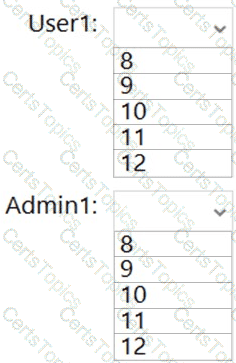
What is the effective minimum password length for User1 and Admin1? To answer, select the appropriate options in the answer area.
NOTE: Each correct selection is worth one point.
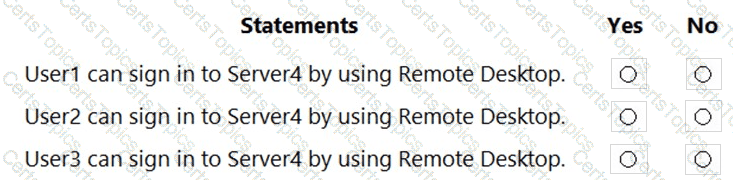
For each of the following statements, select Yes if the statement is true. Otherwise, select No.
NOTE: Each correct selection is worth one point.
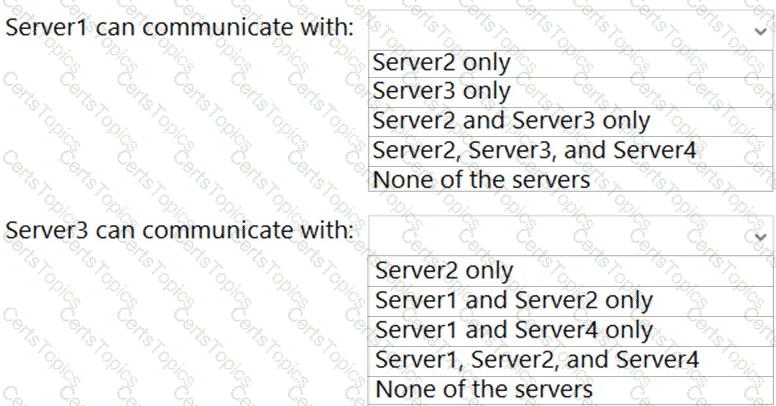
With which servers can Server1 and Server3 communicate? To answer, select the appropriate options in the answer area.
NOTE: Each correct selection is worth one point.
Copyright © 2021-2026 CertsTopics. All Rights Reserved



