You have an Azure subscription that contains the public load balancers shown in the following table.

You plan to create six virtual machines and to load balance requests to the virtual machines. Each load balancer will load balance three virtual machines.
You need to create the virtual machines for the planned solution.
How should you create the virtual machines? To answer, select the appropriate options in the answer area.
NOTE: Each correct selection is worth one point.

You have an Azure subscription named Sub1 that contains two users named User1 and User2 and the resources shown in the following table.
Name
Type
Resource group
RG1
Resource group
Not applicable
RG2
Resource group
Not applicable
VM1
Virtual machine
RG2
VNet1
Virtual network
RG1
VNet2
Virtual network
RG2
User1 is assigned the Owner role for Sub1. User2 is assigned the Contributor role for RG1.
You have two Azure Resource Manager (ARM) templates that are used to deploy virtual machines. The templates have the following configurations:
Name: Template1
CPU: 8-core
RAM: 64 GB
Disk type: Managed
Connected to: VNet2
Resource group: RG1
Name: Template2
CPU: 16-core
RAM: 192 GB
Disk type: Premium
Connected to: VNet1
Resource group: RG1
You create an Azure policy named Policy1. Policy1 is used to manage the deployment of virtual machines that have more than 128 GB of RAM. Policy1 has the following configurations:
Assignment scope: RG1
Exclusion scope: None
Effect: Deny
For each of the following statements, select Yes if the statement is true. Otherwise, select No.

You have a virtual network named VNet1 that has the configuration shown in the following exhibit.

Use the drop-down menus to select the answer choice that completes each statement based on the information presented in the graphic.
NOTE: Each correct selection is worth one point.

Note: This question is part of a series of questions that present the same scenario. Each question in the series contains a unique solution that might meet the stated goals. Some question sets might have more than one correct solution, while others might not have a correct solution.
After you answer a question in this section, you will NOT be able to return to it. As a result, these questions will not appear in the review screen.
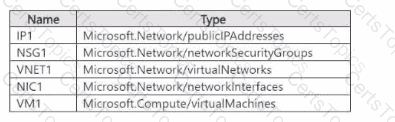
You have an Azure subscription that contains the virtual machines shown in the following table.
You deploy a load balancer that has the following configurations:
•Name: LB1
•Type: Internal
•SKU: Standard
•Virtual network: VNET1
You need to ensure that you can add VM1 and VM2 to the backend pool of LB1.
Solution: You create two Standard public IP addresses and associate a Standard SKU public IP address to the network interface of each virtual machine.
Does this meet the goal?